DWH

From a Flood of Data to a Reliable Data Foundation

From a Flood of Data to a Reliable Data Foundation

DWH Operations

Companies today collect more data than ever before – from ERP systems, CRM applications, IoT sensors, and countless other sources. But data alone doesn’t create value. Only a properly operated data warehouse (DWH) turns the flood of data into a reliable basis for decision-making. In practice, however, it becomes clear: many DWH environments don’t suffer from a lack of tools, but from a lack of operational discipline.

What is Apache Kafka?

What is Apache Kafka?

What is Apache Kafka?

Apache Kafka is a distributed event streaming platform originally developed at LinkedIn and donated to the Apache Software Foundation as an open-source project in 2011. Kafka was specifically designed to reliably receive, store, and forward extremely large volumes of events in real time – with minimal latency even under high load peaks.

Simply put, Kafka works like a highly scalable, durable message log: producers write data into so-called topics, consumers read that data at their own pace. The data is retained in the system for a configurable period of time – unlike traditional message queues, which discard messages after they have been read.

What is Apache Airflow

What is Apache Airflow

What is Apache Airflow?

Apache Airflow is an open-source platform for orchestrating, scheduling, and monitoring data pipelines. Originally developed at Airbnb in 2014, it is today one of the most widely used tools in modern data engineering. The key advantage: workflows are defined not as configuration files, but as Python code – meaning they can be versioned, tested, and reused like software.

What does DAG mean?

What does DAG mean?

What Does DAG Mean?

DAG stands for Directed Acyclic Graph. The term originates from graph theory, but has a central practical significance in data engineering: it describes the dependency structure of tasks or transformation steps that must be executed in a defined order.

Snowflake vs. Azure Synapse vs. BigQuery

Snowflake vs. Azure Synapse vs. BigQuery

Snowflake vs. Azure Synapse vs. BigQuery

Modern data architectures are shifting to the cloud. Classic on-premises data warehouses can reach their limits when faced with growing data volumes, variable load peaks, and the demand for fast deployment cycles. Cloud DWH platforms decouple compute and storage resources, scale elastically, and significantly reduce operational overhead.

Data Build Tool (DBT) Core

Data Build Tool (DBT) Core

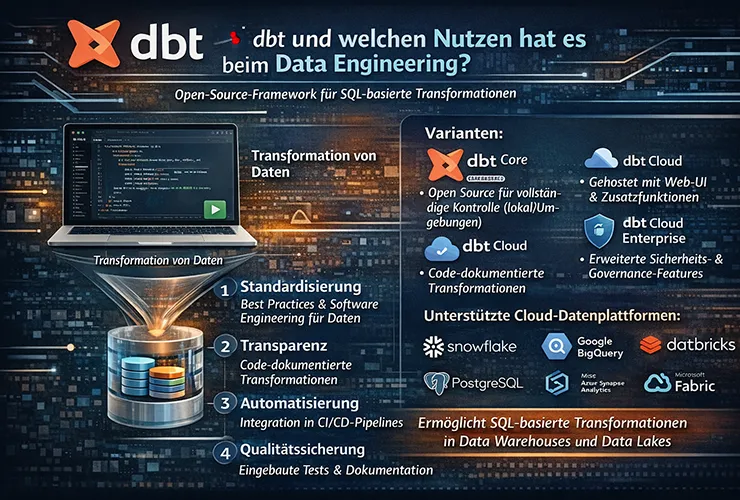
What is dbt and what value does it bring to Data Engineering?

dbt (Data Build Tool) is an open-source framework focused on transforming data within the analytics engineering pipeline. Unlike traditional ETL tools that extract, transform and load data, dbt handles only the transformation step directly inside the data warehouse or data lake. The key advantage is that dbt provides SQL-based transformations in a structured, version-controlled and testable format. This allows teams to develop data models like software – with modularity, reusability and automated testing.

Data Vault

Data Vault

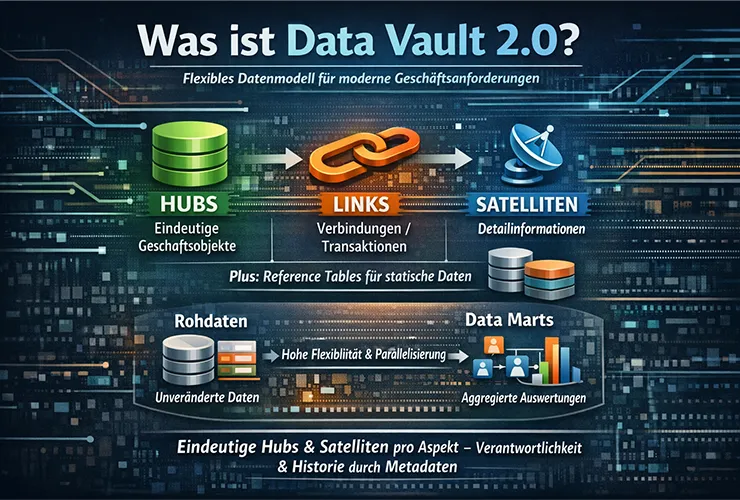
What is Data Vault 2.0?

Data Vault 2.0 describes a design paradigm for data delivery. A key advantage of Data Vault 2.0 is its ability to respond very flexibly to changes in business processes without fundamentally modifying underlying structures. To achieve this, Data Vault 2.0, in contrast to a traditional data warehouse, is not the defined, aggregated truth of all data but rather the neutral provision of all available data. Data aggregation takes place on top of it, for example in data marts.