
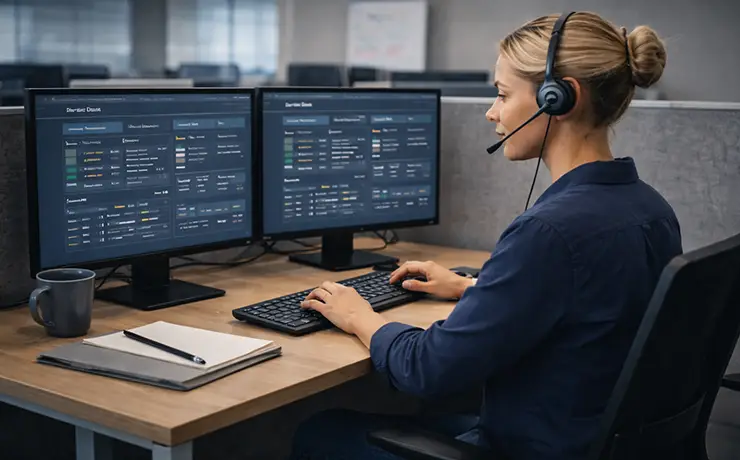
We ensure reliable, structured, and user-oriented IT service. The objective is to resolve incidents quickly, process service requests efficiently, and sustainably maintain the organization’s ability to operate. We understand IT Service & Support as the central interface between IT and business units – transparent, measurable, and process-driven.
Service Desk (Single Point of Contact)
The service desk acts as the central point of contact for all IT-related matters. Requests are recorded in a structured manner, prioritized, and either resolved directly or forwarded to the responsible units.
Typical Use Cases
- Central ticket intake via phone, portal, or email
- Initial diagnosis of incidents
- Coordination of escalations
- Transparent status communication to users
1st & 2nd Level Support
Standard requests and common incidents are handled quickly at the 1st level. More complex issues are managed by the 2nd level with deeper technical expertise.
Typical Use Cases
- Support for client and application issues
- User and access management requests
- Analysis of technical error scenarios
- Close collaboration with platform or application teams
Incident & Request Management
Clear processes ensure structured handling of incidents and service requests. The goal is the rapid restoration of service availability.
Typical Use Cases
- Prioritization of business-critical incidents
- Standardized processing of service requests
- Documentation and tracking of cases
- Analysis of recurring incidents
On-Site & Remote Support
Depending on requirements, support is provided remotely or directly on site, ensuring both efficiency and personalized assistance.
Typical Use Cases
- On-site workplace support
- Remote troubleshooting
- Assistance with hardware replacement
- Support during rollouts and relocations
Knowledge Management
Knowledge is systematically documented and made available to support teams and users. This improves solution quality and first-time resolution rates.
Typical Use Cases
- Development and maintenance of knowledge bases
- Standardized solution documentation
- Self-service articles for users
- Support for new employees in the service team
Service Reporting & Quality Assurance
Services are measured transparently and evaluated regularly. This enables continuous improvement of service quality and response times.
Typical Use Cases
- Analysis of ticket volumes and resolution times
- SLA monitoring
- Service reviews with business units
- Identification of optimization potential
Business Value
A structured IT Service & Support function increases user satisfaction, reduces downtime, and creates operational transparency. ITSS thus becomes a stabilizing factor for productive and efficient business processes.